
What is Annual Contract Value (ACV)?
The definition of Annual Contract Value (ACV) is the average annual revenue generated from a customer contract. Subscription-based businesses and SaaS (Software as a Service) companies have business models that commonly use ACV to track the value of customer contracts and understand the recurring revenue a company can expect from its customers over a year. The metrics companies track include contract length and contract terms for both first-year and multi-year contracts.
What is the ACV Formula?
The formula for ACV can vary slightly depending on the specifics of the contract, but generally, it can be calculated as:
ACV = Total Contract Value ÷ Contract Duration of Years
Where:
- Total Contract Value (TCV) is the total revenue expected from the contract over its entire duration.
- Contract Duration is the length of the contract in years.
What is an Example of an ACV Calculation?
Here is an example of an ACV Calculation:
If a company signs a contract worth $120,000 for a duration of three years, the ACV would be:
ACV=120,000 ÷ 3=40,000
So, the ACV is $40,000, meaning the company expects to generate $40,000 annually from this contract.
What are the benefits of knowing annual contract value ACV?
ACV holds a number of benefits and important metric measurement, including:
- Revenue Forecasting: ACV helps businesses forecast their annual revenue more accurately, which helps different company teams, including sales teams and the CFO office.
- Customer Value Assessment: ACV allows companies to assess the value of their customers over a year and make strategic decisions accordingly.
- Performance Metrics: ACV is a key performance metric for sales and customer success teams, helping them understand the value of the deals they are closing.
- Budgeting and Planning: It aids in budgeting and financial planning by providing a clear picture of expected annual revenue.
Why is annual contract value ACV important in SaaS?
ACV is an important metric for SaaS businesses, which often use subscription or usage-based pricing models. ACV can indicate the following.
1. Revenue Predictability
SaaS companies rely on recurring revenue from subscriptions or consumption-based billing. ACV provides a clear measure of the annual revenue expected from each customer, which helps in predicting and stabilizing revenue streams.
2. Performance Measurement
ACV serves as a key performance indicator (KPI) for sales and customer success teams. It helps these teams understand the value of the contracts they are bringing in and managing, enabling them to set realistic targets and measure their performance effectively.
3. Customer Lifetime Value (CLTV)
ACV is a critical component in calculating the Customer Lifetime Value (CLTV), which is essential for understanding the long-term value of customers. Knowing the CLTV helps in making informed decisions about customer acquisition costs and retention strategies.
4. Budgeting and Financial Planning
With ACV, SaaS companies can more accurately budget and plan for the future. It provides a solid foundation for financial projections, helping in resource allocation, investment planning, and overall financial management.
5. Strategic Decision Making
ACV data helps in making strategic decisions regarding pricing, sales strategies, and product development. It allows companies to identify high-value customers and tailor their strategies to maximize revenue and growth.
6. Investment Attraction
Investors often look at ACV to gauge the health and potential of a SaaS business. A higher ACV indicates a strong, recurring revenue model, making the company more attractive to potential investors and stakeholders.
What is the difference between ACV and ARR?
Annual Contract Value (ACV) and Annual Recurring Revenue (ARR) are metrics used in subscription-based businesses, particularly in SaaS companies. However, they measure different aspects of revenue and have distinct purposes.
ACV represents the average annual revenue generated from a single customer contract. It typically includes recurring subscription revenue, but can also include one-time fees that are spread over the contract’s duration. ACV is used to understand the annual value of individual contracts or customers. It helps in assessing the contribution of each customer to the company’s revenue over a year.
ARR represents the total annual revenue that is recurring and predictable. It sums up all the recurring revenue from subscriptions or contracts on an annual basis. ARR measures the company’s overall recurring revenue health. It provides a snapshot of the total expected revenue from all customers on an annual basis.
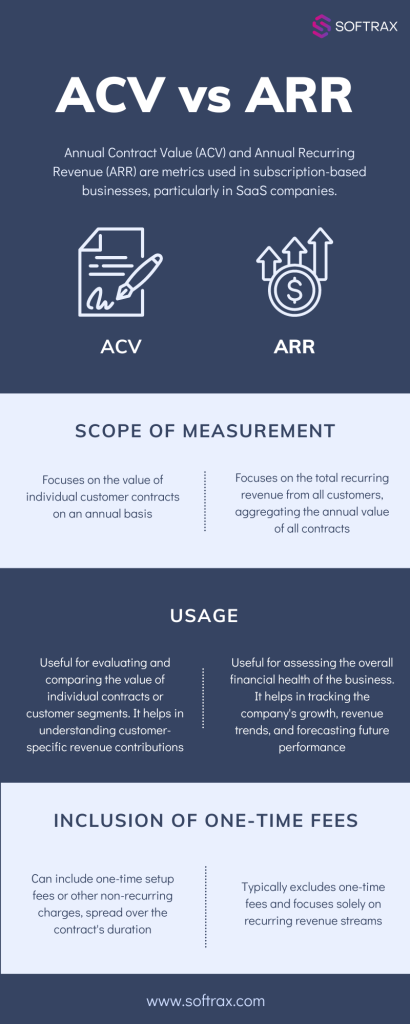
There are key differences between ACV and ARR:
- Scope of Measurement:
- ACV: Focuses on the value of individual customer contracts on an annual basis.
- ARR: Focuses on the total recurring revenue from all customers, aggregating the annual value of all contracts.
- Usage:
- ACV: Useful for evaluating and comparing the value of individual contracts or customer segments. It helps in understanding customer-specific revenue contributions.
- ARR: Useful for assessing the overall financial health of the business. It helps in tracking the company’s growth, revenue trends, and forecasting future performance.
- Inclusion of One-Time Fees:
- ACV: Can include one-time setup fees or other non-recurring charges, spread over the contract’s duration.
- ARR: Typically excludes one-time fees and focuses solely on recurring revenue streams.
What is an example of ACV vs. ARR in a company setting?
Imagine SaaS company CloudPrompt has the following contracts:
Customer A: $1,200 per year
Customer B: $2,400 per year
Customer C: $3,600 per year
- ACV: The ACV for each customer would be $1,200, $2,400, and $3,600, respectively.
- ARR: The ARR would be the sum of all these contracts, i.e., $1,200 + $2,400 + $3,600 = $7,200 per year.
Why are ACV and ARR important?
ACV helps in setting sales targets, evaluating sales performance and marketing efforts as well as understanding the value of different customer segments.
ARR is useful in financial planning, forecasting, and evaluating the overall growth and health of the business. It is a key metric for investors and stakeholders to understand the stability and growth potential of the company.
In summary, while both ACV and ARR are crucial for subscription-based businesses, ACV focuses on the value of individual contracts, whereas ARR provides a comprehensive view of the company’s total recurring revenue. Both provide important insights into renewals, revenue growth, and upgrades, which are useful for sales reps and others to make business decisions.