Navigating the complexities of ASC 606 and IFRS 15? The five-step revenue recognition standard doesn’t have to be a challenge. SOFTRAX RMS streamlines the process, from identifying contracts to recognizing revenue. It automates each step eliminating manual entries and ensuring compliance. Whether it’s subscription billing, discounts, or bundled services, SOFTRAX handles it all with precision. Its advanced analytics and customizable reports give you clarity and control. Say goodbye to spreadsheets and hello to a system that integrates seamlessly with your CRM and ERP systems. Let SOFTRAX manage the complexities of revenue recognition while you focus on growth. Contact us for a demo to see how SOFTRAX RMS can simplify your revenue recognition processes today. Experience the power of compliance automation with SOFTRAX.
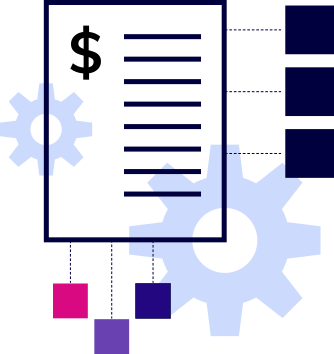
Revenue recognition changed with the introduction of the ASC 606 / IFRS 15 standard, which provided a system for how companies that follow a generally accepted accounting principle (GAAP) recognize revenue around long-term contracts. ASC 606 draws on a five-step process to recognize revenue in terms of a customer contract. Companies then need to put these steps into the context of business model and industry practices.
Companies that implemented ASC 606 may have found disparities with their previous practices that go beyond the capacity of existing systems. Many of these companies have leveraged spreadsheets and other work-around processes as a result to address the five steps of ASC 606 / IFRS 15.

For example, companies in the SaaS industry, or those using subscription or consumption billing, ASC 606 and IFRS 15 can complicate revenue recognition processes. In fact, the nature of processing for these industries triggers some of the most complex areas of ASC 606 and IFRS 15.
The ways that subscription billing / revenue models can trigger ASC 606 complexity include:
SaaS and subscription-model companies especially need to automate complex processes to ensure accuracy and eliminate reliance on manual entries.
Other examples of where companies may see ASC 606 and IFRS 15 complexities are those offering:

Entities that sell multiple performance obligations in the context of a single contract and offer a discount must allocate proportional to the Stand-alone Selling Price (SSP) of each performance obligation.
Contract where products and services are sold with “free” items included, whether it’s maintenance, support, hardware, physical good of some sort, professional services, etc. If it’s determined the free item(s) must be assigned value, the allocation process will do so to properly represent the amount of the transaction price that should be recognized for such performance obligations.

A bundle of products and services sold under a single (or limited number of) line items on a contract or order may inherently represent multiple, distinct performance obligations. This requires an “unbundling” or “carve” of that single line item to many performance obligations to properly represent the totality of the goods and services transferred via the contract with the customer. The allocation process then assigns appropriate amounts from the contract total transaction price to each performance obligation (typically based on the SSP values for each obligation).
Although ASC 606 / IFRS can be complicated, these four steps can be used by companies in all industries for revenue recognition:

The SOFTRAX Revenue Management System (RMS) is the industry’s only system combining billing and revenue recognition in a single application. SOFTRAX RMS is deployed as a layer between CRM/CPQ and ERP, ensuring billing remains close with the customer relationship, while ensuring the proper accounting, security, and controls via a dedicated environment. The result is a sophisticated solution providing a true path to automation and transparency across even the most complex billing and revenue recognition scenarios.
SOFTRAX RMS is fully integrated with a powerful reporting and analytics tool that provides both analytical dashboards and customer-centric drill-down reports for billing accountants, revenue managers, and senior executives alike. SOFTRAX RMS analytics allows users to customize, manage, and share out of the box reports at the summary and detailed account level via simple drag and drop controls. An advanced Workbench keeps revenue accountants focused on the high-priority and high-complexity transactions to ensure policies are correctly applied. SOFTRAX RMS workflow engine simplifies integration with upstream systems, taking on the burden of retries and error-logging.
+