
What is Customer Churn?
Customer churn, also known as customer attrition, refers to the phenomenon of customers stopping their business relationship with a company over a certain period. In revenue management, understanding and managing customer churn is essential for maintaining and increasing revenue. Here’s a detailed overview:
How Do You Calculate Customer Churn?
The general formula for calculating the customer churn rate is:
Churn Rate = Number of Customers Lost during a Period / Number of Customers at the Beginning of the Period X 100
Steps to Calculate Customer Churn
Determine the Time Period
Select a period for which you want to measure churn. This could be monthly, quarterly, or annually, depending on your business model.
Count the Number of Customers Lost
Identify how many customers stopped using your product or service during the selected period. This includes cancellations, non-renewals, or customers who are no longer active.
Count the Number of Customers at the Start of the Period
Determine how many active customers you had at the beginning of the period.
Apply the Formula
Using the formula above, divide the number of customers lost by the number of customers at the start of the period, and multiply by 100 to express it as a percentage.
Example: If you lost 50 customers out of 1,000 at the beginning of the month, your churn rate would be: Churn Rate=50/1000×100=5%
Example Scenario
Let’s say you run a SaaS company, and you want to calculate the monthly customer churn for July.
Number of customers at the beginning of July: 2,200
Number of customers lost during July: 100
Formula: Churn Rate=100 / 1200 × 100 = 4.5%
This means that 5% of your customer base churned in July.
Types of Customer Churn
Voluntary Churn: When customers actively choose to leave, often due to dissatisfaction with the service, better offers from competitors, or changing needs.
Involuntary Churn: When customers leave due to reasons outside their control, such as payment failures, expiration of contracts, or changes in personal circumstances.
Impact on Revenue
High churn rates can lead to significant revenue loss. Acquiring new customers to replace those who churn is often more expensive than retaining existing ones.
Reducing churn helps in stabilizing and potentially increasing revenue by ensuring a consistent customer base.
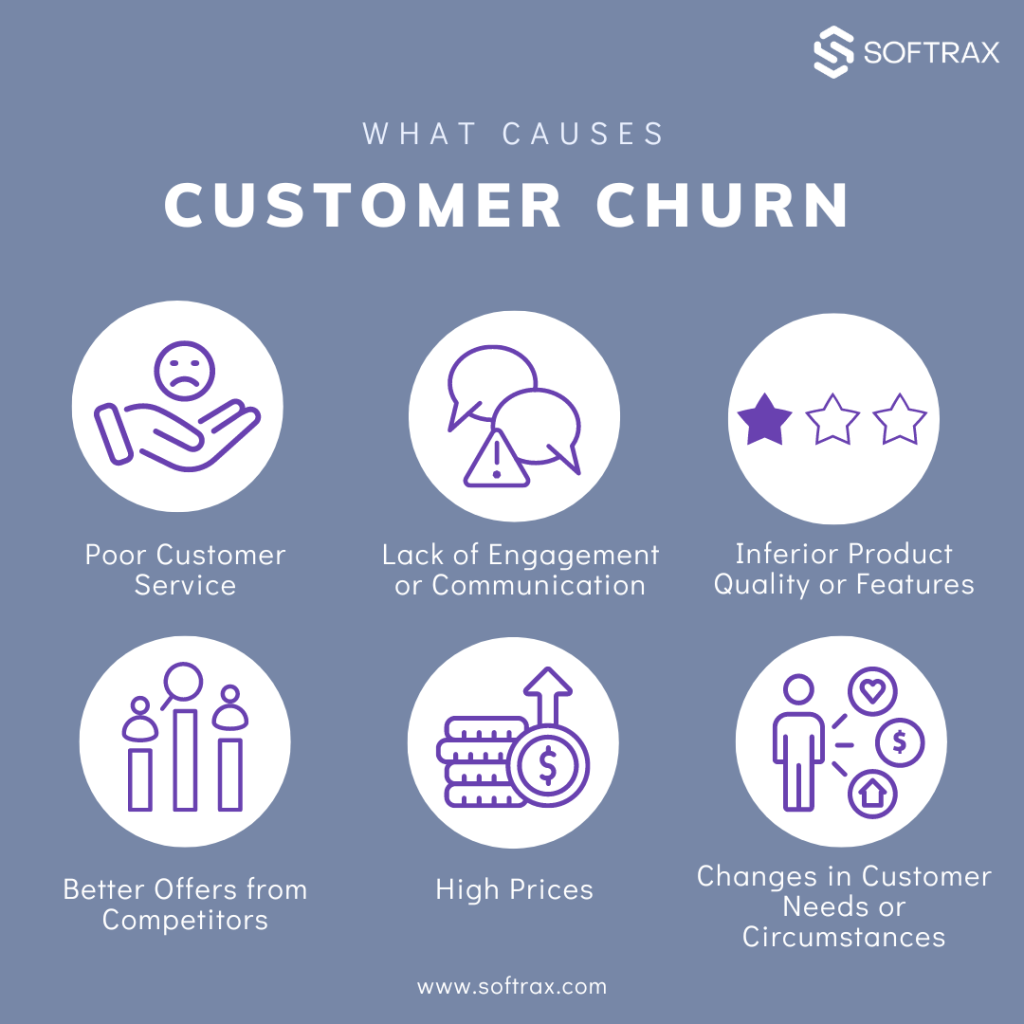
Causes of Customer Churn
- Poor customer service
- Lack of engagement or communication
- Inferior product quality or features
- Better offers from competitors
- High prices
- Changes in customer needs or circumstances
Strategies to Reduce Customer Churn
Improve Customer Experience: Enhancing product quality, providing excellent customer service, and ensuring a positive customer journey.
Customer Engagement: Regular communication, personalized marketing, and loyalty programs to keep customers engaged.
Feedback and Improvement: Collecting and acting on customer feedback to address pain points and improve the product or service.
Predictive Analytics: Using data to predict which customers are at risk of churning and intervening proactively with targeted offers or support.
Customer Churn and Customer Lifetime Value (CLV)
By reducing churn, companies can increase the CLV, which represents the total revenue a business can expect from a customer over their entire relationship.
Monitoring and Analyzing Customer Churn
Regularly tracking churn metrics and analyzing the reasons for churn helps businesses develop effective strategies to mitigate it.
In summary, customer churn is a critical metric in revenue management. By understanding its causes and implementing strategies to reduce it, companies can maintain a stable revenue stream and foster long-term growth.