What is ERP?
Enterprise Resource Planning (ERP) refers to software and systems used by businesses to manage key business processes across departments. The ERP software provides a centralized system with a goal of streamlining operations, improving efficiency, and enhancing decision-making.
What is ERP Software?
ERP software refers to specialized systems that integrate core processes of an organization into a single platform. ERP software lets companies manage operations such as finance, human resources, and sales and marketing efficiently.
What does ERP Software Do?
ERP software allows companies to have a steady workflow and process integration across a number of departments, some of which may be disparate in their function and reporting metrics. ERP software typically contains the following elements:
- Centralized Database: Ensures all departments have the same timely data.
- Automation: Improves workflow and reduces errors from manual inputs.
- Real-Time Reporting: Provides analytics and dashboards so that departments can use the same data for reporting and measurement.
- Customization: Is configured for an individual company’s needs and has the ability to grow with the company.
ERP systems vary by company but some of the common functions that they encompass are:
- Finance & Accounting: Track financial transactions, forecasting, and reporting.
- Human Resources (HR): Manage employee records, benefits, and recruitment.
- Supply Chain & Inventory Management: Oversee procurement, inventory levels, and logistics.
- Customer Relationship Management (CRM): Manage sales, marketing, and customer service.
- Project Management: Help in resource allocation, timelines, and task tracking.
Why is ERP Important?
In the B2B industry, ERP encompasses software systems that help businesses manage and integrate core operational processes across departments. In B2B environments, ERP systems are used to improve efficiency, collaboration, and visibility of different processes.
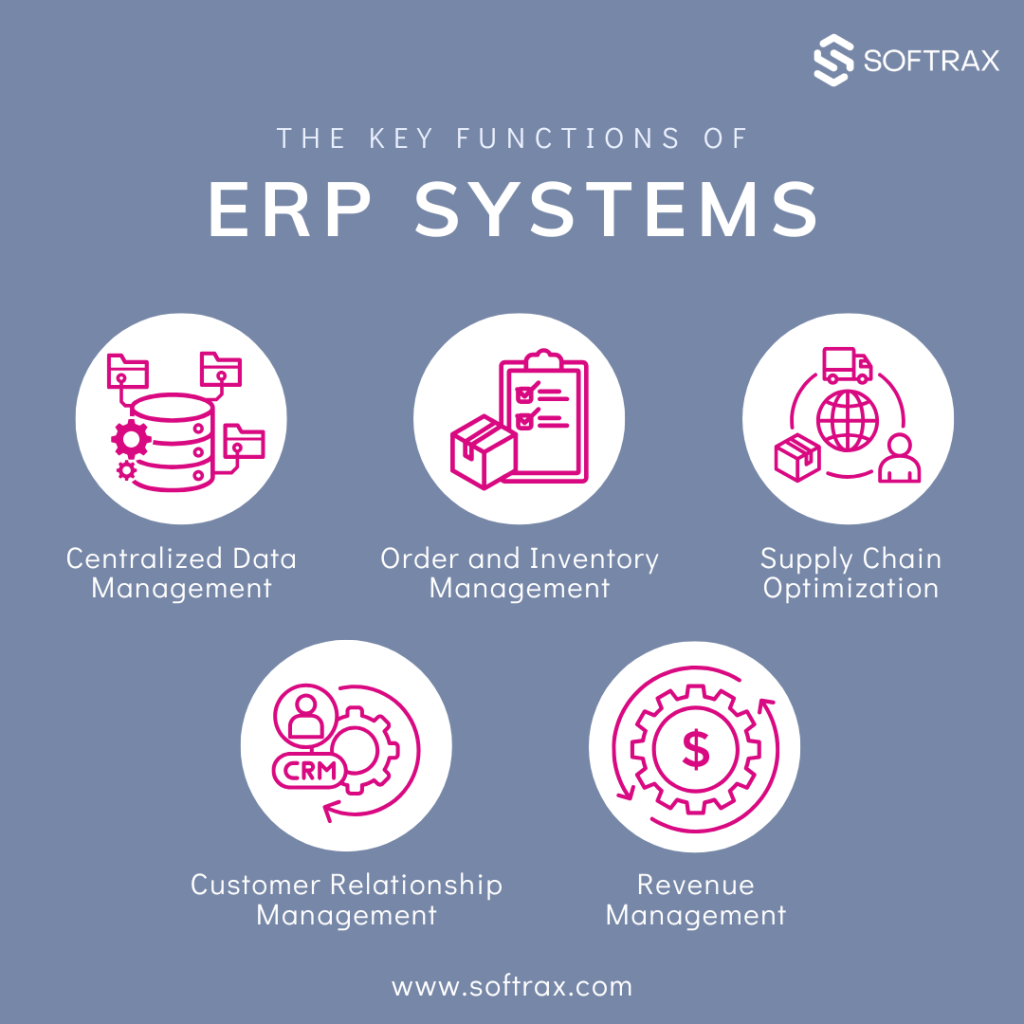
The key functions of ERP systems in B2B are:
Centralized Data Management
ERP systems can integrate data from multiple departments, like sales, engineering, inventory, marketing, and finance into one system. The ERP system can reduce data silos and ensure consistency across functions.
Order and Inventory Management
ERP systems can track real-time inventory levels, helping B2B companies ensure that they have the correct stock as well as automate order processing.
Supply Chain Optimization
ERP systems can coordinate logistics, procurement, and vendor management as well as provide visibility into supply chain metrics.
Customer Relationship Management (CRM)
ERP systems can integrate with CRM tools to streamline customer relationships by tracking customers trends and preferences.
Revenue Management
An ERP system can work with revenue management systems to recognize revenue correctly, automate billing, and comply with regulations.
What are the Benefits of ERP Systems for B2B Companies?
ERP systems can bring the following benefits:
- Improved Efficiency by automating routine processes, reducing time and errors.
- Scalability by adapting as businesses grow or reach new markets.
- Better Customer Experience by streamlining operations to ensure accurate order fulfillment and better services.
What are the Types of ERP Systems for B2B Companies?
ERP systems for B2B companies vary depending on their deployment model, industry, and function. The main types are:
Deployment-Based ERP
- On-Premises ERP: Installed locally on a company’s servers and managed by a company IT team
- Cloud ERP: Hosted on the cloud, and managed by the ERP provider
- Hybrid ERP: A combination of on-premise and cloud-based solutions, allowing for flexibility and gradual migration
Industry-Specific ERP
- Manufacturing ERP: Focuses on production plans, inventory management, and supply chain
- Wholesale and Distribution ERP: These are designed for logistics, order fulfillment, and warehouse management
- Retail ERP: Manages point-of-sale (POS), inventory, and customer relations
- Professional Services ERP: Helps with project management, billing, and resource allocation
- Construction ERP: Tracks contracts, budgets, and project timelines
When Should a B2B Company Use an ERP?
A B2B company should consider implementing an ERP system when it faces challenges in managing business processes efficiently. Some indications that a company would benefit from an ERP system include:
Operational Inefficiencies and Growth Challenges
- Struggling with manual processes that take up staff time and may introduce errors
- Experiencing frequent data inconsistencies between departments.
- Facing scalability issues due to business growth.
Data Management and Decision-Making Difficulties
- Data is scattered across different systems, making reporting difficult
- There is no real-time insight into finances, inventory, or sales
- Forecasting demand and optimizing supply chain operation are not easy
Supply Chain & Inventory Complexity
- Managing a large volume of SKUs with inefficiencies in tracking the stock
- Experiencing delays in procurement, order fulfillment, or delivery
Financial and Compliance Requirements
- Challenges in tracking revenue and expenses
- Difficulty in generating accurate financial reports
- Need to comply with industry regulations
Customer Experience & Order Processing Issues
- Orders are being delayed or lost due to poor coordination among departments
- Customer service struggles due to lack of centralized data
- Difficulties in managing contracts, renewals, and B2B pricing structures
Business Expansion and Multi-Location Management
- Expanding to new markets or international operations
- Need for multi-currency and multi-language support
- Looking to integrate e-commerce, CRM, and sales channels in one system
What is the Difference Between an ERP System and a CRM System?
There are some overlaps between certain ERP and CRM system functions, but the systems have some key differences:
Purpose:
The ERP system focuses on internal business operations and integrates core functions like finance, supply chain, HR, and inventory. It improves overall efficiency and automates processes.
The CRM system typically involves customer interactions and sales, helping businesses manage leads, nurture relationships, and track customer history.
The two systems differ in Key Functions:
Feature | ERP | CRM |
|---|---|---|
Financial Management | Yes | No |
Supply Chain & Inventory | Yes | No |
Manufacturing & Production | Yes | No |
Order & Procurement Management | Yes | No |
Customer Data & Contact Management | No | Yes |
Sales & Lead Tracking | No | Yes |
Marketing Automation | No | Yes |
Customer Support & Ticketing | No | Yes |
Who Uses Which System?
The ERP system is typically used by finance teams, operations managers, procurement, HR, and executives to manage business-wide processes.
A CRM system is most often used by sales teams, marketing professionals, and customer service reps to track leads and improve customer relationships.
Can an ERP Handle Revenue Management?
In the past, ERP systems could handle most revenue management functions, but this ability has diminished with more complicated revenue management structures as well as new compliance mandates. Many companies with ERP systems have added revenue management systems for the following reasons:
Increased Billing Complexity
Many B2B companies have expanded their billing models one-time and milestone to include subscription and consumption billing. Subscription and consumption billing involve measures such as minimums, tiers, and overages, requiring a granular level of focus and tie-in to both revenue management and the customer contract. A separate revenue management system is better able to support these billing models.
Better Automation
Complex billing along with revenue management can be difficult to manage from an ERP alone, as these functions are best automated to save time and reduce reliance on manual input.
Ability to Meet Compliance Mandates
With the introduction of ASC 606 / IFRS 15, companies follow a five-step process for revenue recognition. This process can be complicated for many businesses that use multi-year contracts, including SaaS businesses. A revenue management system can help a company manage their ASC 606 / IFRS 15 reporting and even integrate with an ERP system for some of the data.
Contract Management
Contracts need oversight to meet compliance requirements, ensure that any changes are implemented, and track renewals. A revenue management system can provide a clear channel for contract data.