What is Expansion MRR?
Expansion Monthly Recurring Revenue, or expansion MRR, in a B2B context refers to the additional revenue generated from existing customers through processes like upselling, cross-selling, or upgrading services or products. Expansion MRR is a key metric for SaaS and subscription-based businesses to track monthly revenue increases from their current customer base.
What are the Key Components of Expansion MRR?
Expansion MRR has a number of applications, including:
Upselling is encouraging customers to upgrade to higher-priced tiers or plans for better features or services. For example, a customer on a basic plan might upgrade to a premium plan that provides access to additional features.
Cross-selling is selling additional products or services to existing customers to enhance their initial service. For example, a company may offer complementary services like advanced analytics for the existing product.
Usage-Based Pricing is charging customers based on the amount of a product or service that they use. In the case of Expansion MRR, the usage-based pricing would increase revenue as customers use more of the product or service. A company could provide incentives to have a customer use more than the existing plan outlines, contributing to increased MRR.
What are the Types of Expansion MRR?
The main types of Expansion MRR are:
Upsell MRR
This includes revenue from upgrading customers to a higher-tier plan or a package.
Example: A customer moves from a Basic ($100/month) plan to a Platinum ($150/month) plan, adding $50 in Expansion MRR.
Cross-Sell MRR
This refers to revenue from selling additional products or services related to the main offering.
Example: A SaaS company selling inventory management software adds an AI component for forecasting to a customer’s subscription.
Add-On MRR
This is Revenue from features and services that are optional as well as usage-based charges added to an existing plan.
Example: A cloud storage service charges $100/month for an extra 50GB of storage.
Re-Activation MRR
This Revenue occurs when churned customers return and restart their subscriptions.
Example: A customer cancels a $100/month subscription and returns two months later, adding $100 back into Expansion MRR.
Seat-Based Expansion MRR
This occurs when revenue is gained from customers adding more users (seats) to their existing subscription.
Example: A company pays for 10 users at $10/user and later increases to 15 users, adding $50 in Expansion MRR.
Usage-Based Expansion MRR
Revenue from increased consumption of a usage-based feature.
Example: A cloud-based graphic service charges based on data usage, and a customer increases usage from $300 to $500/month.
Why is Expansion MRR Important?
Expansion MRR is particularly important in B2B because these businesses typically have longer sales cycles and higher customer acquisition costs (CAC), which makes maximizing the value from existing customers a crucial part of revenue growth.
Here are some of the reasons that Expansion MRR is vital in B2B:
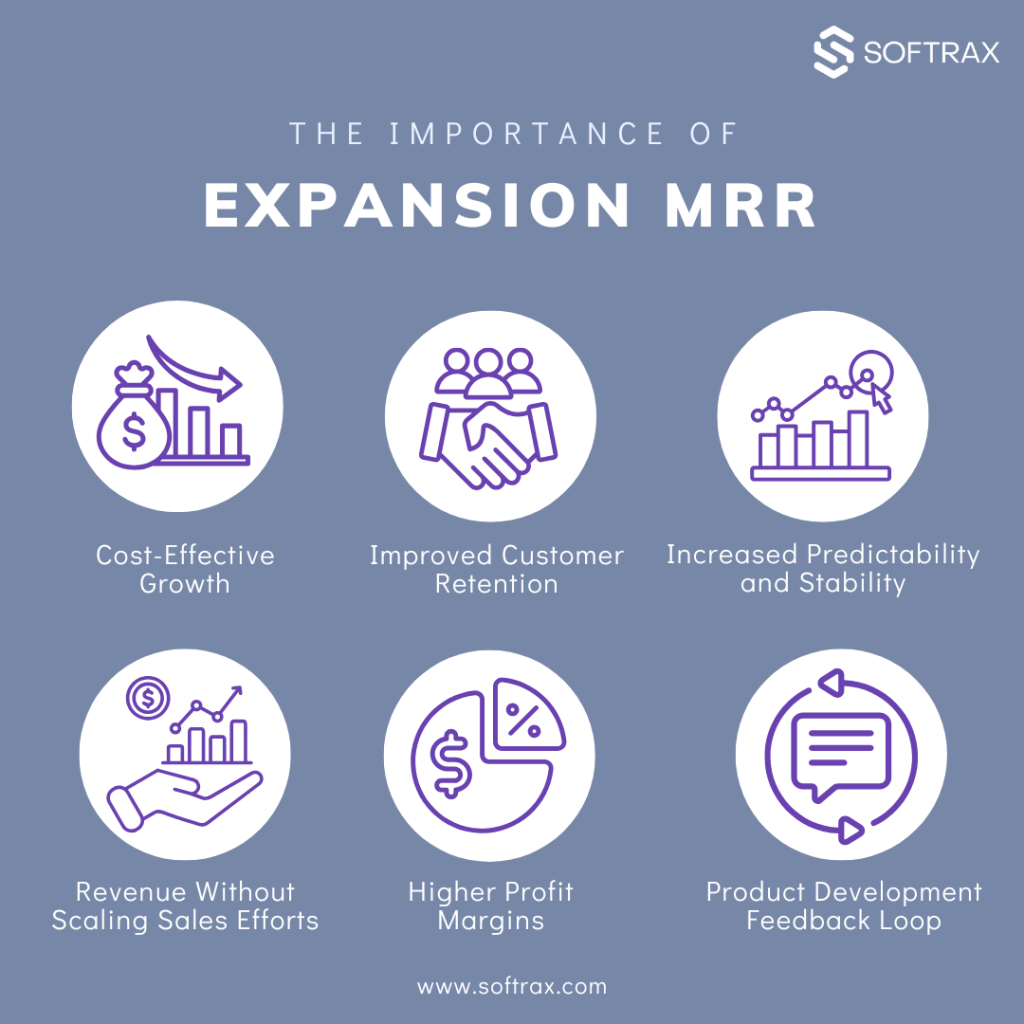
Cost-Effective Growth
Expansion MRR can result in both lower acquisition costs and a maximum customer lifetime value (CLTV). In B2B, acquiring new customers is often expensive and time-consuming due to long sales cycles, complex decision-making processes, and higher CAC. Expansion MRR allows businesses to grow revenue from their existing customer base, which is much more cost-effective than acquiring new customers. By expanding MRR, B2B companies can also increase the lifetime value of each customer. Higher CLTV improves the profitability of each customer relationship, offsetting the initial high costs of acquisition.
Improved Customer Retention
When customers expand their use of a B2B product or service, they are indicating that they value what that company provides. it. The more embedded a B2B solution becomes in a customer’s business processes, the less likely they are to churn.
Increased Predictability and Stability
Since B2B businesses often rely on long-term contracts and recurring revenue models, growing revenue from existing customers through expansion provides a more predictable and stable revenue stream. This reduces the reliance on acquiring new customers for revenue growth. Expansion MRR contributes to a healthier, more sustainable growth pattern, as it’s easier to forecast revenue and plan for future investments based on a stable customer base that is expanding their use of your services.
Revenue Without Scaling Sales Efforts
Expansion MRR allows a company to grow revenue within their current customer base, avoiding the need to increase the sales team or focus their efforts on gaining new logos.
Higher Profit Margins
Expansion MRR tends to come with higher profit margins than new customer acquisition because the costs of servicing existing customers are usually lower. There are typically no marketing expenses, and sales efforts for upselling or cross-selling are typically less intensive than acquiring new customers.
Product Development Feedback Loop
When existing customers upgrade or purchase additional services, it’s a signal that your product meets their evolving needs, and they have faith in your company. This customer commitment can provide valuable feedback for product development teams to refine offerings, add features, or develop new products that further drive Expansion MRR.
What is an Example of an Expansion MRR?
Let’s say a SaaS company offers data analytics software, with the initial customer entry point being a basic plan. Over time, as the customer’s business grows, it needs additional reporting and analytics, resulting in the purchase of additional features. This incremental revenue from the same customer is counted as Expansion MRR.
By growing the Expansion MRR, the SaaS company achieves higher revenue without the need to find new clients, which is particularly valuable in B2B where contracts and relationships are long-term, and switching costs are higher for customers.
What is the Formula for Expansion MRR rate?
The formula for Expansion MRR is the total additional monthly recurring revenue generated from existing customers through upsells, cross-sells, or upgrades in a given month.
Here’s the formula:
Expansion MRR = ∑ (Additional MRR from Existing Customers)
Step-by-Step Breakdown:
- Identify Existing Customers: Focus on customers who are already subscribed to a service.
- Calculate Additional MRR: For each customer, calculate the increase in their MRR due to upsells (upgrading to a higher plan), cross-sells (purchasing additional services or features), or increased usage (for usage-based pricing models).
- Sum Up All the Increases: Add up the additional MRR from all existing customers who increased their spending in that month.
For example, if a company has 10 existing customers who upgraded their plans, adding $20,000 in additional MRR in a given month, the Expansion MRR would be $20,000.
What is the Relationship of Expansion MRR to Other Metrics?
Expansion MRR is closely related to several other key metrics in B2B, subscription-based, or SaaS businesses. Understanding its relationship with these metrics provides a comprehensive view of a company’s growth, revenue health, and customer success efforts in addition to the Expansion MRR. Here are the main connections:
- Expansion MRR positively impacts Net MRR Growth, offsetting any losses from churned or contracted customers. The more existing customers upgrade or buy additional products, the higher the net MRR growth will be.
- Churned MRR: Expansion MRR helps counteract Churned MRR. If your Expansion MRR is greater than your Churned MRR, you can still achieve positive net revenue growth even when some customers leave.
- Contraction MRR: Similar to how it acts with Churned MRR, Expansion MRR offsets Contraction MRR. A high Expansion MRR can help neutralize the impact of customers reducing their spend.
- New MRR: Expansion MRR works in tandem with New MRR to drive overall revenue growth. While New MRR comes from new customer acquisitions, Expansion MRR focuses on growing revenue from your existing base, offering a balance between acquisition and retention.
- While Gross MRR Churn looks at revenue lost, Net MRR Churn Rate (which accounts for Expansion MRR) shows the true impact of customer behavior on revenue. If Expansion MRR exceeds churn, your Net MRR Churn Rate could be negative, meaning your business is still growing even with customer losses.
- Net Dollar Retention (NDR) / Net Revenue Retention (NRR): Expansion MRR boosts NDR/NRR by increasing the overall revenue from your existing customers. High NDR/NRR is a sign of a healthy business because it shows you’re generating more revenue from your existing customer base, even when factoring in customer churn.
- Customer Lifetime Value (CLV): Expansion MRR increases the revenue per customer, which directly increases the CLV. By growing the MRR from existing customers, businesses can extend customer relationships and make each customer more valuable.
- Customer Acquisition Cost (CAC) Payback Period: By increasing the MRR from existing customers, Expansion MRR shortens the CAC Payback Period. When customers spend more, businesses can recover their acquisition costs faster.
- Annual Recurring Revenue (ARR): Expansion MRR directly increases MRR, and by extension, boosts ARR. It helps businesses hit higher revenue targets without needing to rely entirely on new customer acquisition.
What is a Good Expansion MRR Rate?
A good Expansion MRR rate will depend on the industry, business model, and company size, but in general:
- 10-30% of total MRR growth should come from Expansion MRR.
- A net revenue retention (NRR) rate of 110-130% (which includes Expansion MRR minus churn) is considered excellent.