What is Flat-Rate Pricing?
Flat-rate pricing is a fixed, predetermined price that is charged for a product or service and does not vary by product usage or consumption. It is simple, predictable model and is commonly used in subscription-based models, SaaS, and service industries.
Flat rate pricing works by offering:
- One price for all customers: There are no tiers, usage-based fees, or variable costs.
- Fixed recurring fee: The fee is billed at a fixed rate, often times monthly
- “No Surprise” billing: Customers always know what they will be charged
What Else Means Flat-Rate Pricing?
There are a number of synonyms for flat-rate pricing, including:
- Fixed Pricing
- Flat-Fee Pricing
- All-Inclusive Pricing
- Standard Pricing
- Fixed-Rate Pricing
- Single-Tier Pricing
- One-Price Model
- Simple Pricing
- Uniform Pricing
- Set Fee Structure
How Does Flat-Rate Pricing Work?
In flat rate pricing, a company charges a customer a single, fixed price on a set schedule. For example, a business offering subscriptions for an information repository offers a flat fee of $50 per month for access. This price remains the same regardless of how many times a customer accesses the repository. The billing is also consistent with the customer receiving an invoice for the same amount each month.
What are the Pros of Flat-Rate Pricing?
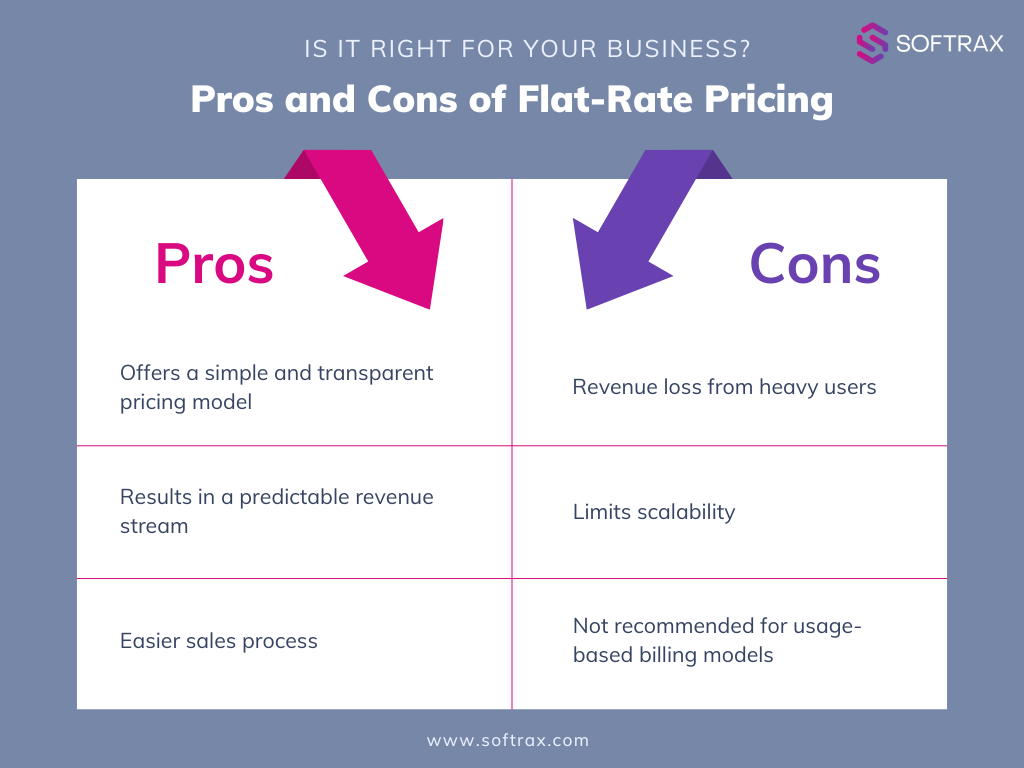
The pros of flat-rate pricing are:
- Offers a Simple and Transparent model: Easy for customers to understand.
- Results in a predictable Revenue stream: Good for forecasting income.
- Easier Sales Process: There are no complex pricing structures, so contracts are easier.
What are the Cons of Flat-Rate Pricing?
The cons of flat-rate pricing are:
- Revenue Loss From Heavy Users: High-usage customers will get more value for the same price.
- Limits Scalability: The model makes it difficult to charge larger businesses more.
- Not Recommended for Usage-Based Models: Companies with variable costs will lose profitability with this model.
Is Flat-Rate Pricing a Good Model for My Business?
It depends on your business type, industry, and overall goals.
Flat-rate pricing might work if:
- You offer standardized services/products with predictable costs.
- Customers value simplicity and transparency.
- You want to avoid haggling or time-based billing confusion.
- Your margins are healthy enough to absorb cost variations.
- You won’t lose profits if customers overuse your product or service.
Flat-rate billing might not work if:
- Your costs vary significantly per job/project.
- Your business requires a high level of customization
- You risk underpricing complex jobs or overpricing simple ones.
What are Examples of Flat-Rate Pricing?
Some examples are:
SaaS and Subscription Services
- A graphic software charges $99/month per company for all features.
- A streaming service charges $40/month, no matter how much you watch.
Professional Services and Consulting
- A PR firm charges $3,000 for an annual plan draft instead of hourly billing.
- A consulting firm offers a flat $10,000 package for a supply and demand model.
IT and Managed Services
- A cybersecurity firm provides managed security for $1,000/month.
- A CRM system offers unlimited access for $50/month.
E-commerce and Retail
- A food subscription box service charges $50/month for a curated delivery.
- A shipping company offers flat-rate shipping for $20, no matter the package weight or the distance it will travel.