What is In-Advance Billing?
In-advance billing for B2B refers to a billing method where a customer is charged upfront for a service or product before it is delivered to or used by the customer. This billing model is common in subscription-based businesses or in industries where services are provided on a recurring basis. The company collects payment for a future period and delivers the service throughout that period.
What are Key Features of In-Advance Billing?
Upfront Payment: The customer is required to pay for the product or service before it is delivered or used, typically at the start of the business cycle.
Recurring Services: The billing model is often used in tandem with subscription or recurring service models, where payment is made before the next round of services starts.
Predictable Cash Flow: For businesses, in-advance billing offers a predictable revenue stream.
Contract-Based: Many B2B relationships operate on contracts with specific terms (e.g., monthly or annual agreements) where advance billing is stipulated.
What are Examples of In-Advance Billing in B2B?
SaaS: Many SaaS companies bill their clients at the start of each billing cycle for the upcoming service period. For example, a data analytics software provider might charge $1,000 at the beginning of the month for access to the platform during that month.
Consulting Firms: Some consulting firms charge retainers, or in-advance payments, for a block of hours or services that will be delivered in the future. A client might pay upfront for a certain number of consulting hours to be used over a set period.
Cloud Hosting Services: Cloud service providers may offer advance billing for a certain number of resources or service plans. Customers are charged upfront for the amount they plan to use.
Telecom and Internet Services: Telecom providers often charge business customers in advance for the upcoming month’s services (e.g., phone lines, internet access, or data plans).
What are the Advantages of In-Advance Billing?
In-advance billing offers several advantages for B2B companies, particularly when it comes to improving cash flow, reducing financial risk, customer retention, and enhancing revenue predictability. Here are some of the key benefits of this billing method for B2B companies:
Improved Cash Flow
Upfront Payments: Receiving payments before delivering the service helps businesses maintain a steady cash flow, enabling them to cover operating expenses. This is especially important for businesses with recurring costs or significant up-front investments needed to deliver their services.
Liquidity for Growth: With predictable cash inflow, businesses have additional liquidity that they can reinvest in growth initiatives like marketing, product development, or hiring new talent.
Revenue Predictability
Stable Income Stream: In-advance billing provides a clear, predictable income stream. Companies can more accurately forecast their revenue, as they already know the amounts to be paid in the upcoming billing period.
Reduced Payment Risk
Lower Risk of Default: Since customers pay upfront, there’s a reduced risk of late payments or non-payment.
Customer Commitment and Retention
Increased Customer Commitment: Customers who pay upfront for services are more likely to stay committed to using the product or service through the billing period. This can help reduce churn rates, especially in subscription-based models.
Locking in Contracts: In-advance billing often ties customers to a fixed-term contract (monthly, quarterly, or annually), securing their loyalty for a longer period. This gives companies a better sense of customer retention over time.
Reduced Administrative Burden
Streamlined Payment Processing: Collecting payments upfront reduces the need for multiple payment reminders and follow-ups, saving time and resources that would otherwise go into managing late payments.
Incentives for Long-Term Contracts
Discounting Opportunities: B2B companies often use in-advance billing to incentivize long-term commitments for customer retention. Offering discounts for upfront payments (e.g., an annual subscription at a lower rate) encourages customers to choose longer contract periods, which stabilizes the business’s revenue.
What would you use In-Advance Billing for?
In-advance billing is used in a number of industries to secure revenue upfront, improve cash flow, and reduce financial risk. Some examples are:
Subscription and SaaS Businesses:
These businesses can charge customers in advance in annual or quarterly upfront increments vs. charging them monthly. The annual or quarterly billing can encourage long-term commitments and reduce churn.
Professional Services & Agencies: These companies typically collect a retainer fee before starting work. The retainer is an in-advance payment that protects against unpaid invoices for time-based work.
Manufacturing and Wholesale Orders: These companies typically require partial or full upfront payment to cover production costs. This offers a level of financial protection for producing large orders.
Events, Conferences and Training Programs: These companies charge attendees in advance to secure spots and cover expenses. The fees help in paying for overhead and personnel costs and can prevent last-minute cancellations.
Enterprise Software & Licensing: Large B2B contracts may require prepaid licensing fees for multi-year deals. This practice reduces the risk of unpaid renewals.
What are the Challenges of In-Advance Billing for B2B businesses?
While in-advance billing offers numerous advantages for B2B businesses, it also comes with some significant challenges. These challenges can impact cash flow management, customer relationships, and the overall operational process. Below are some of the key challenges that B2B businesses face with in-advance billing:
Customer Resistance to Upfront Payments
Cash Flow Constraints for Customers: Many B2B customers may have their own cash flow issues and could be reluctant or unable to pay upfront for services or products, especially for long-term contracts. This is particularly challenging for small businesses or startups that prefer to spread payments over time to retain as much cash as possible.
Customer Trust: Customers might be hesitant to pay upfront if they are uncertain about the quality of the service or the company’s ability to deliver on promises.
Risk of Churn and Customer Dissatisfaction
Perception of Risk: Customers might feel they are taking on too much risk by paying for a service or product that has not yet been delivered. If the service doesn’t meet their expectations, they may have a negative perception of the company providing the service.
Refund and Cancellation Challenges: When customers are billed in advance, cancellation policies and refund requests can become more complicated. If a customer decides to cancel midway through a contract or if the service is not satisfactory, handling partial refunds or disputes can lead to frustration on both sides.
Revenue Recognition and Accounting Complexity
Deferred Revenue: With in-advance billing, revenue must be recognized over the period during which the service is provided, according to ASC 606 / IFRS 15. The compliance with these mandates can create complexity in financial reporting, as payments received upfront do not immediately translate to recognized revenue. Companies need a good system for recording the payment as the service is rendered.
Upfront Payment Discounts
Reduced Margins: To incentivize customers to pay in advance, B2B companies often offer discounts for upfront payments. While this helps with securing cash flow, it can reduce profit margins in the long run.
Risk of Over-Discounting: Businesses may feel pressure to offer significant discounts to secure long-term commitments, which can erode profitability, especially if the upfront payment isn’t substantial enough to cover the long-term cost of the product / service.
Impact on Sales and Customer Acquisition
Longer Sales Cycles: Asking for upfront payments may extend the sales cycle, as customers need more time to evaluate the risk and their own cash flow before committing. This is especially true for larger enterprises with formal procurement processes, which may involve multiple layers of approval for advance payments.
Challenges in Managing Refunds and Disputes
Refund Complications: In scenarios where customers are dissatisfied or wish to cancel their services, managing refunds can be tricky, especially when multi-service contracts are involved. Determining the amount to be refunded (e.g., partial refunds for unused services) and handling the logistics of repayment can be time-consuming.
What are examples of In-Advance Billing in B2B?
In-advance billing is a good B2B model for services or products that are delivered over a fixed period or as part of a subscription model. Here are examples of in-advance billing scenarios in B2B across different sectors:
SaaS: A data analytics software provider bills its clients at the beginning of each billing cycle (monthly, quarterly, or annually) for the upcoming service period.
- Scenario: A business purchases a set amount of usage on the data analytics platform for $12,000 over a year. The company pays the entire amount upfront for the year, and the service is provided over the next 12 months. If the client cancels mid-year, a partial refund for the unused months may be issued based on the contract terms. If the client goes above the usage amount in the contract for $12,000, they may be charged for the overage use.
Cloud Hosting Services: A cloud computing provider charges businesses for a predetermined amount of storage, server space, or computing power, with in-advance payment.
- Scenario: A company signs up for a cloud hosting service, paying $1,000 upfront for 6 months of cloud storage and bandwidth. The cloud service is available throughout this period.
Telecommunications and Internet Services: Many telecommunications companies bill business clients in advance for monthly services like internet access or data plans
- Scenario: A telecommunications provider bills a business client $500 at the start of each month for their internet, VoIP phone services, and data plan. The services are then provided continuously throughout the month.
Managed IT Service: An IT support company charges businesses upfront for a block of services (e.g., network maintenance, cybersecurity, or support hours) that will be delivered over a set time period.
- Scenario: A managed IT service provider bills a business $5,000 upfront for quarterly services that include server maintenance, network monitoring, and help desk support. The payment is made at the beginning of the quarter, and the IT provider delivers services as required during that quarter.
Professional Services (Consulting, Legal, etc.): Consulting firms or legal service providers often charge retainers upfront, covering future services to be rendered.
- Scenario: A consulting firm charges a $15,000 retainer at the beginning of a project for a marketing strategy consultation. The consulting work is carried out over the next three months, and the company draws down from the retainer as hours are used.
Subscription-Based Data Providers: B2B companies providing access to industry reports, market research, or data analytics often bill upfront for access to their databases or premium content over a set period.
- Scenario: A market research firm bills a corporate client $20,000 for an annual subscription to its premium data reports and market insights. The client has access to all research throughout the year, with payment fully made in advance. The client may have to pay extra to access higher tier reports.
Enterprise Software Licensing: Companies that sell enterprise software often use advance billing for long-term licensing agreements.
- Scenario: A company purchases an annual license for an enterprise ERP software for $50,000. This payment covers software usage, support, and updates for the next 12 months.
What is the Difference Between In-Advance Billing and Billing in Arrears?
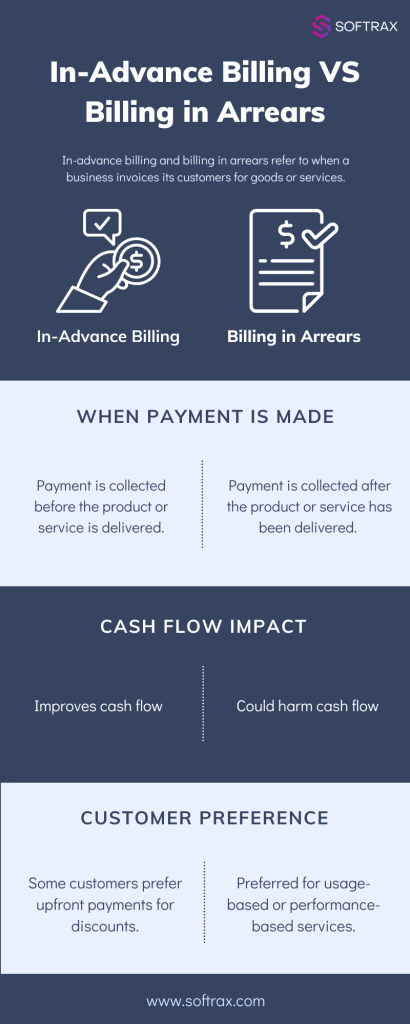
In-advance billing and billing in arrears refer to when a business invoices its customers for goods or services. The key difference is timing:
Billing Type | When Payment is Made | Common Use Cases |
|---|---|---|
In-Advance Billing | Payment is collected before the product or service is delivered. | SaaS subscriptions, retainers, annual software licenses, manufacturing deposits, event tickets. |
Billing in Arrears | Payment is collected after the product or service has been delivered. | Employee payroll, utilities, postpaid phone plans, commission-based services, consulting fees. |
In-Advance Billing (Prepaid)
- The customer pays upfront before using the product or service
- The practice ensures businesses receive revenue before incurring service costs
- The practice is common for SaaS, retainers, cloud services, and manufacturing
Billing in Arrears (Postpaid)
- The customer pays after using the product or service
- The practice is common when costs are variable or based on usage
- The practice is used in payroll, utilities, postpaid phone plans, and contractor work
Key Differences
Factor | In-Advance Billing | Billing in Arrears |
|---|---|---|
Timing | Paid before service delivery. | Paid after service delivery. |
Cash Flow Impact | Improves cash flow | Could harm cash flow |
Customer Preference | Some customers prefer upfront payments for discounts. | Preferred for usage-based or performance-based services. |