What is a Contract Asset?
In terms of revenue recognition, a contract asset refers to the rights a company has to receive consideration for goods or services that have been transferred to a customer, but where the payment is not yet unconditional. To say it another way, it’s an asset that represents the company’s right to payment for work performed or goods delivered under a contract, but where the payment is still dependent on something other than the passage of time.
Key Points:
- Performance Obligations: Contract assets arise when a company has fulfilled some or all of its performance obligations under a contract, but the company has not yet received payment.
- Unconditional Rights: These are distinguished from receivables, where the right to payment is unconditional and only depends on the passage of time.
- Revenue Recognition Standard: Under ASC 606 / IFRS 15, revenue is recognized when a company satisfies a performance obligation, but the related asset or liability (contract asset or liability) is recognized depending on the contract terms and payment conditions.
- Contract Liability: The opposite of a contract asset is a contract liability, which represents the company’s obligation to transfer goods or services to a customer for which the company has received consideration (or an amount of consideration is due) from the customer.
What is an Example of a Contract Asset?
Let’s say a construction company is building a house for a customer. As the company progresses on the construction and meets various milestones, it recognizes revenue corresponding to the work completed. However, the customer might only be billed upon reaching certain milestones, creating a contract asset for the revenue recognized but not yet billed.
Why are Contract Assets Important?
Contract assets are crucial in financial reporting under ASC 606 / IFRS 15 because they represent a company’s right to consideration in exchange for goods or services that the company has transferred to a customer. Understanding and correctly accounting for contract assets is essential for accurate financial reporting and analysis.
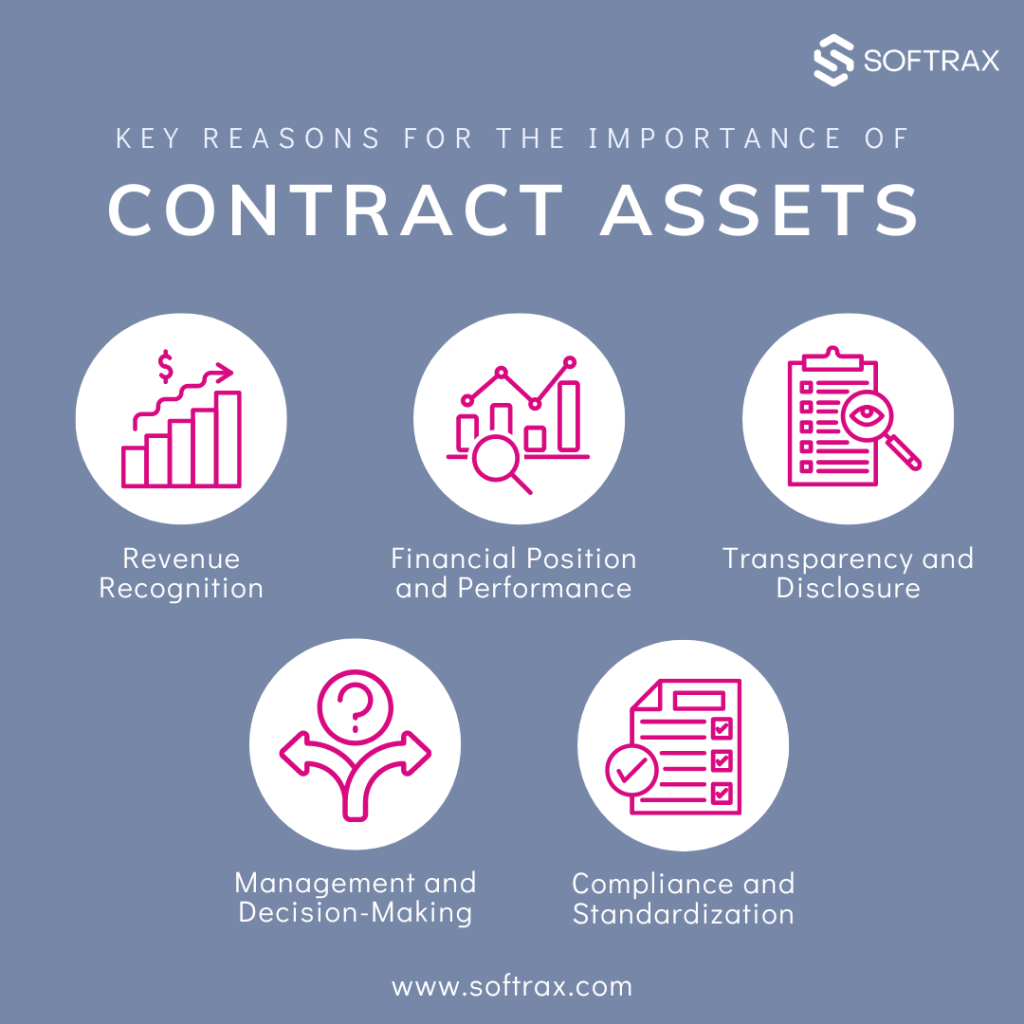
Key Reasons for the Importance of Contract Assets
1. Revenue Recognition
- Timing of Revenue: Contract assets impact the timing of revenue recognition. They arise when a company performs its obligations under a contract, but the payment is contingent on something other than the passage of time. Recognizing contract assets helps align revenue with the actual delivery of goods or services.
- Performance Obligations: Contract assets reflect the completion of performance obligations, even if the payment is deferred. This accurate reflection of performance ensures that revenue is recognized in the correct accounting period.
2. Financial Position and Performance
- Accurate Measurement: Contract assets contribute to a more accurate measurement of a company’s financial position. They are included on the balance sheet as assets, providing a clearer picture of the resources the company controls.
- Future Cash Flows: They provide insights into future cash flows. Since contract assets represent future payments, the company expects to receive, they help investors and analysts assess the company’s liquidity and cash flow potential.
3. Transparency and Disclosure
- Detailed Information: Contract assets require detailed disclosure, enhancing transparency in financial reporting. Companies must provide information about the nature, amount, timing, and uncertainty of revenue and cash flows related to contract assets.
- User Understanding: These disclosures help users of financial statements understand the company’s contractual arrangements, performance obligations, and the risks and uncertainties associated with them.
4. Management and Decision-Making
- Internal Management: For internal management, contract assets are crucial for tracking the progress of contracts and performance obligations. This tracking helps in better managing projects, forecasting revenues, and making informed business decisions.
- Contract Negotiations: Understanding contract assets assists in negotiating terms and managing customer relationships, as it provides insights into when and how much consideration is expected to be received.
5. Compliance and Standardization
- Adherence to Standards: Recognizing and reporting contract assets is a requirement under ASC 606 and IFRS 15. Compliance with these standards ensures that the company’s financial statements are prepared in accordance with Generally Accepted Accounting Principles (GAAP) or International Financial Reporting Standards (IFRS).
- Consistency: Standardized accounting for contract assets ensures consistency in financial reporting, making it easier to compare financial statements across different periods and companies.
What are the Key Differences Between AR and Contract Assets?
Accounts Receivable (AR) represent the amounts due to a company from its customers for goods or services that have been delivered or provided but not yet paid for by the customer.
There are Differences Between AR and Contract Assets:
Billing Status
AR: Represents amounts that have been billed to customers and are due for payment.
Contract Assets: Represents amounts for work performed but not yet billed because the right to payment is conditional on further performance.
Payment Condition
AR: Payment is unconditional and due according to the invoice terms.
Contract Assets: Payment is conditional on meeting additional performance obligations or milestones.
Recognition Timing
AR: Recognized when an invoice is issued.
Contract Assets: Recognized when work is performed, even if not yet billed.
Nature of Asset
AR: Represents a right to payment that is unconditional.
Contract Assets: Represents a right to payment that is conditional on future events.
What is an Example of an AR and a Contract Asset?
Consider a software development company working on a custom project:
- Accounts Receivable: The company completes a module of the software, issues an invoice for $10,000, and records this amount as AR.
- Contract Asset: The company completes 40% of the project, with a milestone payment due at 50% completion. The costs and progress associated with the 40% completion are recorded as a contract asset because the right to payment is conditional on reaching the 50% milestone.
What is the Difference Between Unbilled Receivables and Contract Assets?
Unbilled receivables and contract assets are terms often used interchangeably in practice, but they have distinct meanings under accounting standards, particularly ASC 606 and IFRS 15. Here’s a detailed explanation of their differences:
Unbilled Receivables
Unbilled receivables refer to amounts that a company is entitled to receive for goods or services delivered but for which an invoice has not yet been issued. This typically occurs when the company has performed its obligations and is awaiting the right time to bill the customer, which is often governed by the terms of the contract.
Characteristics:
- Performance Obligation Completed: The company has completed its performance obligations, but billing is pending due to the timing of invoicing.
- Unconditional Right to Payment: The right to payment is usually unconditional, meaning the company is entitled to the payment, but the invoice has not yet been issued.
- Recognition: Unbilled receivables are recognized when the company has a right to consideration for completed performance obligations, and the right to payment is unconditional.
- Presentation: Unbilled receivables are typically recorded as accounts receivable on the balance sheet.
Contract Assets
Contract assets, on the other hand, arise when a company has performed work or delivered goods but the right to payment is conditional on something other than the passage of time, such as additional performance obligations or reaching specific milestones outlined in the contract.
Characteristics:
- Performance Obligation Incomplete or Conditional: The company may have partially completed its performance obligations, and the right to payment is contingent upon further performance or specific conditions being met.
- Conditional Right to Payment: The right to payment is conditional upon the completion of additional performance obligations or achieving specific milestones.
- Recognition: Contract assets are recognized when the company performs its obligations, but the right to payment depends on future events or conditions.
- Presentation: Contract assets are recorded separately from accounts receivable on the balance sheet and are disclosed as “contract assets.”