
What is a Contract?
For companies in business-to-business (B2B) industries, a contract is a legally binding agreement between two or more businesses outlining the terms and conditions of their relationship. These contracts are essential for defining the expectations, obligations, and rights of each party involved, helping to ensure clarity and prevent disputes.
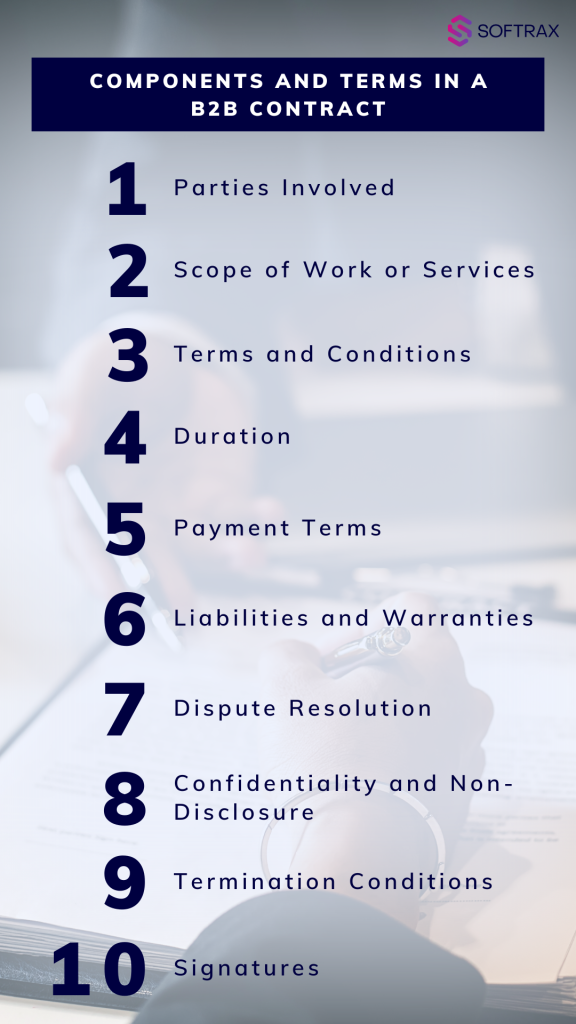
What Are the Components and Terms in a B2B Contract?
- Parties Involved: The contract specifies the businesses entering into the agreement, including their legal names and addresses.
- Scope of Work or Services: A detailed description of the products, services, or work to be provided, including specifications, quality standards, and deliverables.
- Terms and Conditions: The specific terms under which the business relationship will operate, such as payment terms, delivery schedules, and confidentiality agreements.
- Duration: The period the contract covers, including start and end dates, and any conditions for renewal or termination.
- Payment Terms: Details on the pricing, payment schedule, and methods of payment. This may also include penalties for late payments or discounts for early payments.
- Liabilities and Warranties: Clauses that define the responsibilities of each party, including warranties for products or services, and limitations on liabilities in case of breaches or damages.
- Dispute Resolution: Procedures for resolving disputes, including mediation, arbitration, or litigation, and the jurisdiction where disputes will be resolved.
- Confidentiality and Non-Disclosure: Provisions to protect sensitive information exchanged between the parties during the business relationship.
- Termination Conditions: The circumstances under which the contract can be terminated by either party, including notice periods and any penalties for early termination.
- Signatures: The contract is typically signed by authorized representatives of each business, indicating their agreement to the terms and conditions.
Examples of B2B Contracts
- Service Agreements: Contracts for professional services, such as consulting, IT services, or marketing support.
- Supply Agreements: Contracts for the supply of goods or raw materials needed for production or resale.
- Distribution Agreements: Contracts outlining the terms under which one business distributes another’s products.
- Partnership Agreements: Contracts defining the terms of a partnership between businesses, including profit sharing, responsibilities, and governance.
- Lease Agreements: Contracts for leasing equipment, office space, or other assets.
By clearly outlining the terms of a business relationship, B2B contracts help ensure both parties understand their obligations and expectations, reducing the risk of misunderstandings and legal disputes.
Why are B2B Contracts Important?
B2B contracts offer stability, clarity, and legal protection in business relationships. Some of the ways that B2B contracts are beneficial include:
- Legal Protection: Contracts establish legally binding agreements between parties so that if disputes arise, the contract serves as a reference to resolve conflicts and determine legal responsibilities.
- Clarity of Terms: Contracts help to clarify the obligations, responsibilities, and expectations of each party. This clarification helps to reduce misunderstandings by outlining the commitments of each party.
- Risk Mitigation: Contracts often include clauses that mitigate risks, such as liability limitations, indemnity provisions, and dispute resolution mechanisms.
- Payment Security: B2B contracts usually specify payment terms, including amounts, deadlines, and conditions for payment. This clarification helps to ensure that both parties agree on financial matters and provides a basis for enforcing payment obligations.
- Confidentiality and Intellectual Property Protection: Many B2B contracts include confidentiality clauses to protect sensitive information and intellectual property.
- Regulatory Compliance: Contracts often address compliance with relevant laws and regulations, ensuring that both parties operate within legal and regulatory boundaries.
- Protection of Assets and Investments: Contracts can help to safeguard investments made by both parties, ensuring that resources, time, and capital are used efficiently and that there is recourse if the agreement is breached.
- Dispute Resolution: In case of disagreements, contracts often outline specific processes for resolving disputes, such as mediation or arbitration. This helps avoid lengthy and costly legal battles.
What are the Benefits of B2B Contracts?
B2B contracts offer benefits that can enhance and stabilize the business relationship, including:
- Clear Expectations and Accountability: B2B contracts outline the roles, responsibilities, and expectations for each party involved, which helps prevent misunderstandings.
- Legal Protection: Contracts provide legal recourse if one party fails to fulfill its obligations.
- Risk Management: B2B contracts can include provisions that limit liability, outline responsibilities for unforeseen events, and establish procedures for handling disputes. These provisions help reduce risk and helps protect both parties from unexpected problems.
- Payment Assurance: Through the process of defining payment terms, including amounts, deadlines, and conditions, B2B contracts help ensure that timely and accurate payments are more likely to occur.
- Stronger Business Relationships: With a well-crafted B2B contract, the provisions can enable trust between businesses by setting clear terms and expectations.
- Operational Efficiency: The clear terms and processes defined in the B2B contract can be a means to operational efficiency by helping to reduce delays, improve communication, and ensure that both sides are aligned on project timelines and deliverables.
How is a Contract Different from an Agreement?
While all contracts are agreements, not all agreements are contracts. A B2B contract is a specific type of agreement that is formal, legally binding, and designed to provide clarity and protection in a business relationship. An agreement can be a broader and less formal understanding between parties, which may or may not have legal enforceability. Here is how they differ.
1. Formality
A B2B Contract is a formal, written document that outlines specific terms and conditions agreed upon by the parties. It is typically more detailed and structured. An Agreement can be an informal or a formal understanding between the parties, doesn’t have to be in writing, and does not have the detailed structure of a contract.
2. Legal Enforceability
A B2B Contract is a legally binding document. If one party fails to meet their obligations, the other party can take legal action to enforce the contract. An Agreement may or may not be legally binding. For an agreement to be enforceable as a contract, it must meet certain legal criteria – such as offer, acceptance, consideration, and mutual intent.
3. Specificity
A B2B Contract is specific in terms of obligations, rights, timelines, penalties, and other conditions. They leave little room for interpretation, covering all aspects of the business relationship in detail. An Agreement can have less specificity and may not include all of the details that a contract would cover. They often reflect a mutual understanding without diving into the fine details of execution.
4. Documentation
A B2B Contract is typically documented in writing, signed by both parties, often with witnesses or notarization. They are designed to be official records of the business relationship. An Agreement in writing may lack the formalities of contracts, such as signatures or legal language.
5. Clarity and Certainty
A B2B Contract provides clear, unambiguous terms, leaving little room for differing interpretations. In addition a B2B Contract outlines specific remedies in case of breach and details how disputes will be resolved. An Agreement may be more open-ended, allowing for flexibility, but without the clear terms of a contract.
6. Purpose
A B2B Contract is typically implemented for significant, long-term, or complex business relationships, where formalized terms are necessary to protect both parties. An Agreement can be used for simpler, short-term, or less critical interactions where a general understanding is all that is needed.
7. Dispute Resolution
A B2B Contract usually includes clauses that are for dispute resolution, such as through arbitration, mediation, or litigation. These clauses provide a clear path for handling conflicts. As agreements do not explicitly state dispute resolution agreements, leaving parties with no set agreed-upon course for disputes should they arise.
What Do B2B Companies Need to Know About Contract Renewals?
Contract renewals are crucial for B2B businesses as they can significantly impact revenue stability and customer relationships. Below are some key points B2B businesses need to consider about contract renewals.
1. Understanding Contract Terms and Conditions
- Review Contract Clauses: Carefully review the terms of existing contracts to understand renewal clauses, termination rights, notice periods, and any conditions that may affect the renewal process.
- Pricing and Terms Changes: Be aware of any clauses that allow for price changes or modifications to terms upon renewal.
2. Customer Communication and Relationship Management
- Proactive Engagement: Engage with customers well before the contract renewal date to discuss their needs, satisfaction with current services, and any potential changes.
- Negotiation: Be prepared to negotiate terms, pricing, and services to meet the evolving needs of the customer while maintaining profitability.
3. Timing and Notice Periods
- Advance Notice: Ensure that you provide the required advance notice of renewal or termination as specified in the contract. Missing notice periods can lead to automatic renewals or lost contracts.
- Automated Reminders: Use CRM systems to set reminders and alerts for upcoming renewals to avoid missed deadlines.
4. Performance Evaluation
- Assess Service Delivery: Review your performance against the contract terms to identify any areas where you may need to improve or adjust your offerings.
- Customer Feedback: Gather feedback from the customer to understand their satisfaction levels and areas for improvement.
5. Compliance and Legal Considerations
- Regulatory Requirements: Ensure that contract renewals comply with any relevant legal and regulatory requirements, which may vary by industry and jurisdiction.
- Contract Management Software: Use contract management software to track, manage, and store contracts to ensure compliance and easy retrieval.
6. Financial Implications
- Revenue Forecasting: Consider the financial impact of renewals on your revenue forecasts and business planning.
- Discounts and Incentives: Evaluate the use of discounts, incentives, or loyalty programs to encourage renewals and strengthen customer relationships.
7. Customizing Offerings
- Tailored Proposals: Customize renewal proposals to address the specific needs and preferences of the customer, offering additional services or value-added options where appropriate.
- Bundling Services: Consider bundling services or products in the renewal contract to provide more value and encourage longer-term commitments.
8. Market and Competitor Analysis
- Competitive Landscape: Stay informed about market trends and competitor offerings to ensure that your renewal terms remain competitive.
- Value Proposition: Clearly articulate your value proposition and how it aligns with the customer’s goals and challenges.
9. Data and Analytics
- Customer Data: Utilize data analytics to understand customer behavior, usage patterns, and satisfaction levels to inform renewal strategies.
- Predictive Insights: Leverage predictive analytics to identify customers at risk of not renewing and develop targeted strategies to retain them.
10. Internal Coordination
- Cross-Functional Collaboration: Ensure coordination between sales, customer success, finance, and legal teams to streamline the renewal process and address any issues promptly.
- Training: Provide training for account managers and customer-facing teams on effective renewal strategies and negotiation skills.
Summary
B2B businesses need to adopt a proactive, data-driven approach to contract renewals, focusing on customer engagement, performance evaluation, compliance, and financial planning. By understanding the specific needs and preferences of their customers and staying informed about market dynamics, businesses can enhance their renewal rates and maintain strong, long-term customer relationships.