
What is Customer Attrition?
Customer attrition, also known as customer churn, refers to the loss of customers over a given period. In the context of revenue management, customer attrition is a critical metric because it directly impacts a company’s revenue and growth.
How do you measure the Customer Attrition Rate?
The Customer Attrition Rate (also called Customer Churn Rate) measures the percentage of customers who stop doing business with a company over any given period of time.
Here’s the formula to calculate it:
Customer Attrition Rate (%) = Number of Customers Lost During the Period divided by the Total Number of Customers at the Start of the Period ×100
Steps for Measuring the Customer Attrition Rate
First, define the time period.
Second, identify the total customers at the start.
Third, determine the lost customers.
Fourth, plug the numbers into the formula.
For Example:
Let’s say a company has 1000 customers at the start of the measured period, and they lose 100 customers in the same period. The attrition rate would be:
100 divided by 1000 x 100.
The attrition rate in this case is 10 percent.
What are some additional measures that are useful in working with Customer Attrition?
In addition to tracking customer attrition rates, the following measures should also be considered:
Segmentation: This is determined by breaking down churn by customer segments to identify high-risk groups.
Comparison: This is measured by comparing the attrition rate over different periods in order to spot trends.
Retention Efforts: This is found from insights into reducing churn, such as loyalty programs, improved customer service, or product enhancements.
How Does Customer Attrition Impact Revenue?
Customer Attrition has both short-term and long-term revenue impacts for a company, meaning that it is an issue that has long-reaching implications.
In the short-term, customer attrition can result in:
Immediate Loss of Revenue
When customers leave, the company loses the revenue generated from the product or service, with the actual loss being determined by the contractual terms. For certain business models, such as subscription-based or recurring revenue, the loss of revenue can be more significant.
Increased Acquisition Costs
Replacing customers is typically more expensive than retaining current customers. If there is a high customer attrition rate, the business will need to put more financial and personnel resources into recruiting new customers.
Reduced Customer Lifetime Value (CLV)
The customer lifetime value is a key metric for understanding the customer profitability over time. Attrition decreases the average CLV, which in turn, can lead to reduced profit margins.
In the long-term, customer attrition can lead to:
Impact on Brand Reputation
If the customer attrition rate is high and goes on for a prolonged period, this attrition could be seen as a larger problem with the company’s overall offerings. This could deter new customers, further reducing revenue.
Erosion of Up-Sell and Cross-Sell Opportunities
For many companies, revenue is also attained from up-selling and cross-selling opportunities with existing customers. Customer attrition reduces these opportunities and can have a negative impact on overall profitability.
Scaling Challenges
For growing companies, there is a need to scale, which requires significant resources. If there is a high attrition rate, companies will be forced to use these resources to replace the lost customers.
What Causes Customer Attrition?
Understanding what causes customer attrition is crucial for revenue management, and some of the common reasons that customers stop engaging with a business include:
Poor Customer Experience
If the customer feels that they are not a priority, they may discontinue a business relationship or stop a service. Some company actions that can lead to a poor customer experience are unresolved customer complaints, slow response times to issues raised by the customer, lack of a personalized experience (feeling that they are just a number), and inconsistent quality of the product or service.
High Prices or Perceived Lack of Value
If a company’s products or services are priced high, or if the customer feels that they are not getting value for price, they are more likely to consider leaving.
Lack of Engagement
A company’s products or services may be performing properly, but the business can still risk customer attrition by not paying attention to its customer base. Regular communication to engage the customer base can provide an important outlet for feedback. Similarly, active company communication can alert customers to product updates, special promotions, or new offerings.
Product or Service Issues
If a company’s product has frequent technological issues or limited features, especially when compared with competitors’ offerings, then customers may want to leave. Similarly, if products and services do not keep pace in offering innovative solutions, customers may look elsewhere for service.
Competition
Companies should always have an eye on the competitors, especially to avoid customer churn. Does a competitor have a stronger product offering or a better price? Or, is a competitor launching a strong marketing campaign that targets your company? All of these are reasons that customers may leave.
Misalignment with Customer Needs
Companies need to make sure that their offerings fit a customer need and are delivering continued value. To do this, a company needs to be aware of the customer’s preferences as well as market trends.
Negative Brand Perception
Companies should make sure to address directly any bad reviews, public relations issues, or any areas of concern about the company, its products, or its services. This direct approach will allow the company’s position to be known as well as open lines of communication.
Economic Factors
Companies may see the product or service as non-essential during economic downturns. Or, the company may be forced to raise the price of the product or service to keep pace with rising costs, which leads to affordability issues.
Lack of Loyalty Programs
These programs can be an incentive to stay as good rewards, discounts, and other benefits can be a driver for long-term relationships.
Internal Company Issues
Customers may leave a company that has different messaging or experiences across channels. Similarly, if there is a high employee turnover, customers may leave due to fallout from the turnover.
Lack of Innovation
Companies need to evolve with market trends and customer preferences. No customer wants to be left with outdated technology.
What are Strategies to Reduce Customer Attrition?
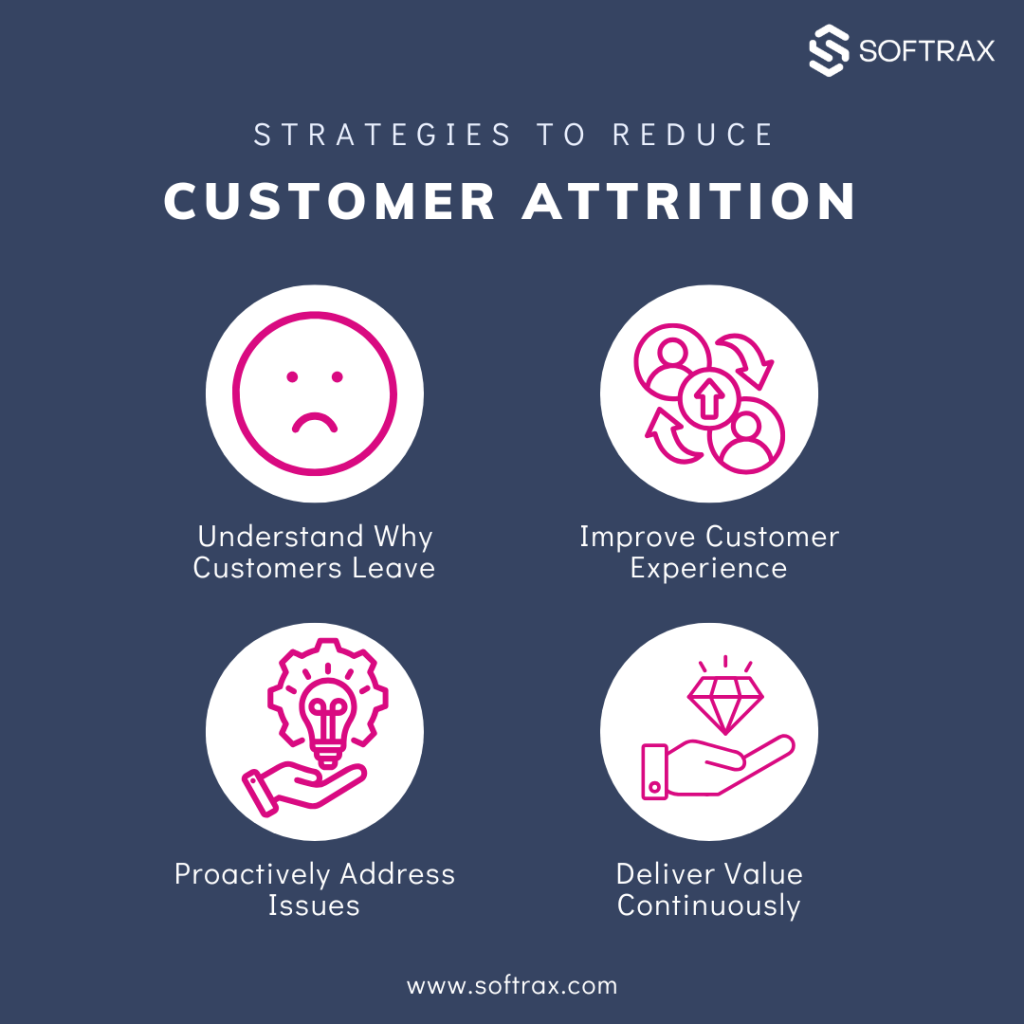
Companies use various strategies to reduce attrition, such as:
Understand Why Customers Leave
Customer feedback can show issues with the product or service that need to be addressed. Also, companies can use churn data to analyze the situations in which customers are likely to leave, allowing them to do proactive outreach to possible at-risk customers.
Improve Customer Experience
If customer attrition rates start to rise, companies should look at their customer service, onboarding, and support processes. There may be improvements that can help strengthen the customer experience.
Proactively Address Issues
If issues are arising that could lead to customer attrition, companies can offer incentives or launch win-back campaigns. Companies can also look at usage patterns to identify customers that may be disengaging and therefore at risk of leaving.
Deliver Value Continuously
There are many ways in which a company can deliver value to their customers, such as regular product updates, communications on the benefits of the product or service, promotions, and mirroring offerings to match those of the competition.
How does Predictive Analytics Fit into Customer Attrition?
Predictive analytics can be an important tool for understanding and mitigating customer churn. Some examples include:
Identifying At-Risk Customers: Predictive analytics can analyze patterns of reduced engagement – behavioral analytics – to identify customers likely to churn.
Recognizing Churn Drivers: Predictive tools can identify factors contributing to the attrition, such as pricing concerns, problems with features, or product quality problems. In addition, analytics can study customer feedback to build predictive models.
Designing Retention Strategies: Predictive analytics can help with tailored retention programs, such as loyalty rewards or personalized content. These retention strategies can include dynamic adjustments to mirror customer behaviors.
Measuring Retention Campaign Effectiveness: Predictive analytics can assess the efficacy of retention strategies and build on insights to improve the retention efforts.
An example of how predictive analytics can help with customer attrition:
Let’s say a subscription-based company uses predictive analytics to monitor customer engagement. The program can involve the following steps:
Data Collection: The subscription company can gather data on usage frequency, customer support interactions, and billing history.
Model Building: This data can be used to build a predictive model to assign churn likelihood scores to customers.
Actionable Insights: The company can identify those customers with high churn scores to receive tailored outreach, such as discounts or personalized support.
Outcome Monitoring: The company can also track the impact of interventions on churn rates and update the model accordingly.
Why is Customer Attrition Important?
Customer attrition is a crucial metric for SaaS businesses to understand because it directly impacts revenue, growth, and profitability.
Here are some important areas to consider:
Revenue Loss: Many SaaS companies rely on recurring revenue, so losing customers means a direct reduction in monthly or annual recurring revenue (MRR/ARR).
Customer Acquisition Costs (CAC): With churn, SaaS companies need to replace the customers they lost, and acquiring new customers is expensive. If the churn rate is high enough, the revenue from the new customers may not cover the lost revenue from churn. Also, a high churn rate for SaaS typically means that the business must invest in marketing and sales to keep pace.
Lifetime Value Reduction: A long-standing customer means a higher lifetime value (LTV) for that customer. A high churn rate shortens customer LTV, reducing overall profitability.
Negative Market Perception: High churn rates mean that the customers are not satisfied, whether by the performance of the product or service, or by the overall customer experience. News of high churn rates will be seen as a negative not only to potential customers but also to potential investors.