What is a Contract Amendment?
From a revenue recognition standpoint, a contract amendment refers to any change in the terms and conditions of an existing contract. These changes can include modifications to the scope of the contract, the price, the timing of delivery, or other aspects that alter the original agreement between the parties involved.
Key Points of Contract Amendments for Revenue Recognition
Modification Identification
A contract amendment is identified as a modification when the parties to the contract approve a change that creates new or changes existing enforceable rights and obligations.
Assessment of Modification
Separate Contract: If the amendment adds distinct goods or services at their standalone selling prices, it is treated as a separate contract.
Modification of Existing Contract: If the amendment does not meet the criteria for a separate contract, it is treated as a modification of the existing contract, with a modification being a change to the terms of a contract, including changes to the price, timing, or quantity of the goods or services provided.
Treatment of Modifications
Prospective Treatment: If the remaining goods or services are distinct from those already transferred, the modification is accounted for prospectively, meaning the existing contract is adjusted, and future revenue is recognized based on the new terms.
Cumulative Catch-Up: If the remaining goods or services are not distinct from those already transferred, the modification is accounted for using a cumulative catch-up approach, adjusting the revenue recognized to date to reflect the new terms.
Combination: In some cases, the modification may contain elements of both prospective treatment and cumulative catch-up. An example of a typical contract combination is when two or more contracts are considered together because they are involving the same customer, are entered into around the same time, and the performance of one contract directly impacts the consideration (payment) of another.
How Do You Amend a Contract?
Amending a B2B contract involves modifying the terms or provisions in the existing agreement between two businesses. Some typical steps include:
Review the Original Contract
First, a business would check to see if the contract has an Amendment Clause, which is a provision that outlines how modifications can be made. Such a clause may require written consent from both parties or other acknowledgements of an agreement to amend the contract from the of the specific procedures to be followed. The next step would be for the businesses to identify the provisions to be amended.
Draft the Amendment Document
The Amendment should include clear language identifying the changes, such as titling the document “Amendment to [Original Document], including the date of the amendment and the date of the original contract. Then, the businesses should clearly state the Amendments to be made, using clear specific language as well as the day on which the amendments will take effect.
Obtain Agreement from Both Parties
This is typically done by having both parties sign the amendment. The signing should be done by an authorized representative and typically includes having Witnesses present or having the document notarized.
Register or Notify Relevant Authorities (If Needed)
Depending on the terms of the contract. The amended contract may require that formal notification be made to regulatory bodies or similar organizations.
What Are Some Examples of Contract Amendments
Amendments for B2B contracts can take different forms, depending on the complexity of the amendment or the terms of the original contract. Examples include:
A Separate Contract may be needed for the amendment. An example is software that has a contract to deliver a software license and provides ongoing support for a client. If the customer later requests additional licenses for a separate product sold by the company, both companies may decide that a separate contract that lists the product and standalone selling price makes the most sense.
A Modification of the existing contract may cover the changes that need to be made without the need for a new contract. For example, if a construction company is building a bridge and the customer requests additional features that are not distinct from the ongoing work. This request could be treated as a modification of the existing contract, potentially requiring a cumulative catch-up adjustment to revenue recognized to date.
Accounting Treatment of Contract Amendments
Update Contract Assets and Liabilities: Reflect the impact of the amendment on contract assets and liabilities.
Reassess Performance Obligations: Determine if any new performance obligations have been created or if existing ones have been modified.
Adjust Transaction Price: Update the transaction price to reflect the revised terms.
- Revenue Recognition: Recognize revenue based on the updated contract terms, either prospectively or with a cumulative catch-up adjustment.
Understanding and appropriately accounting for contract amendments is crucial to ensuring accurate revenue recognition and financial reporting.
What is the Difference Between a Contract Amendment and a Contract Addendum?
The difference between a B2B contract amendment and a contract addendum lies in the purpose and scope of each. Both modify or clarify a contract, but they are used in distinct ways:
1. Contract Amendment
Purpose: An amendment modifies the terms or conditions of an existing contract. It changes the original agreement by updating, adding, or deleting specific clauses.
Scope: The amendment specifically alters the content of the contract itself, replacing certain parts of the original agreement.
Examples:
- Changing payment terms
- Extending the contract duration
- Modifying service levels or product specifications
Effect: The contract remains in force with the amended terms. The amendment is considered part of the original contract, and the rest of the contract remains unchanged unless specified.
2. Contract Addendum
Purpose: An addendum adds additional information, terms, or clauses to the existing contract without changing the original terms. It supplements the contract, often to clarify or provide more details about certain aspects of the agreement.
Scope: An addendum is a separate document that adds to the original contract, but the contract itself remains unchanged.
Examples:
- Adding additional services to a contract
- Providing clarification on existing clauses
- Specifying conditions that weren’t originally addressed
Effect: The original contract stays intact and enforceable, with the addendum becoming an extension that complements the original agreement.
Key Differences of Contract Amendments and Addendums
Aspect | Contract Amendment | Contract Addendum |
|---|---|---|
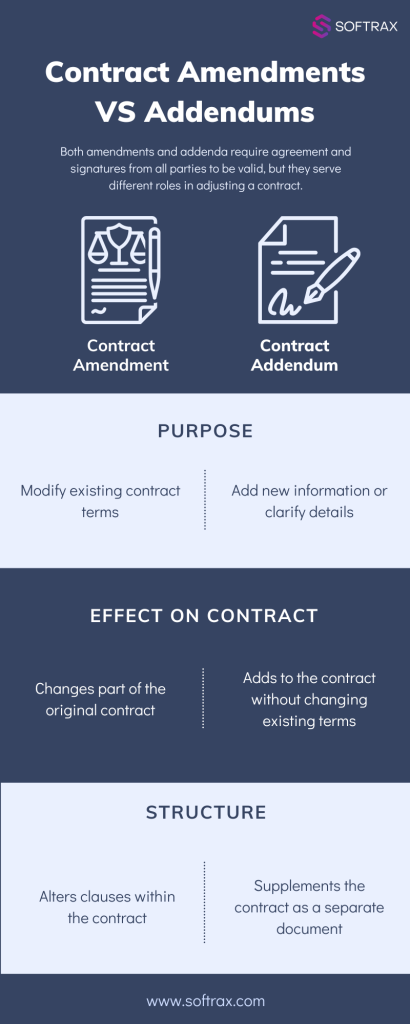
Purpose | Modify existing contract terms | Add new information or clarify details |
Effect on Contract | Changes part of the original contract | Adds to the contract without changing existing terms |
Structure | Alters clauses within the contract | Supplements the contract as a separate document |
Example | Change in pricing terms | Adding a new product line or service not previously listed |
Both amendments and addenda require agreement and signatures from all parties to be valid, but they serve different roles in adjusting a contract.